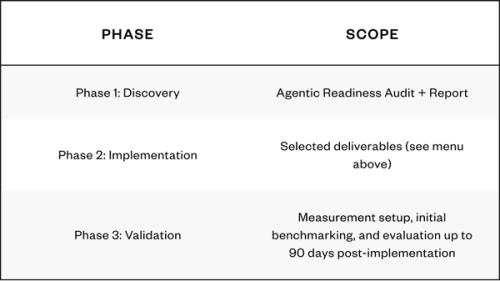
Phase 2: Implementation
TIMELINE: 4-8 WEEKS (VARIES BY SCOPE)
Phase 2 is a personalized menu of deliverables. Not every store needs every item - the Discovery audit determines which improvements will have the highest impact for your specific catalog and competitive position. Each deliverable below includes its purpose, whether it's primarily a code or content effort, and an hours estimate.
Catalog Data Optimization
CONTENT + CODE
A comprehensive metafield strategy that moves critical product attributes out of unstructured description fields and into machine-readable structured data. This is the single highest-impact deliverable for agentic commerce readiness - an AI agent can only recommend what it can understand, and metafields are how Shopify communicates product attributes to AI systems via the Catalog API.
The work includes defining and implementing metafield definitions for material composition, provenance/origin, care instructions, occasion and use-case tagging, size and fit details, and any vertical-specific attributes relevant to your product category. We create the metafield schema, configure definitions in Shopify Admin, and provide documentation and templates for your team to populate at scale.
For stores with large catalogs, we develop a prioritized rollout plan - starting with hero products and bestsellers, then expanding coverage systematically.
Shopify Taxonomy Alignment
Code + Content
Shopify's standard product taxonomy powers automatic category attribute assignment across AI platforms. When your products use specific, accurate taxonomy categories (e.g., "Women's Waterproof Hiking Boots" rather than "Footwear"), Shopify auto-populates a rich set of category-specific attributes that AI agents use for filtering and recommendation.
This deliverable reviews your current category assignments across the full catalog, maps products to the most specific applicable taxonomy nodes, and ensures variant grouping aligns between your storefront presentation and catalog data. The goal is to maximize the automatic attribute coverage that Shopify provides for free when taxonomy alignment is correct.
JSON-LD Structured Data Implementation
CODE
Structured data markup tells AI crawlers and search engines exactly what your content represents, in a standardized format they can parse directly. Sites with structured data are significantly more likely to be cited by AI systems - research indicates roughly 65% of pages cited by Google AI Mode and 71% of pages cited by ChatGPT include structured data markup.
We implement JSON-LD schemas (or optimize existing schemas) across all relevant content types in your Liquid theme:
- Product -
- Organization
- BreadcrumbList
- FAQPage
- Article / BlogPosting
- Crawler access
- Knowledge Base status
- Brand authority signals
All schemas are validated against Google's Rich Results Test and Schema.org specifications, and implemented as reusable Liquid snippets for maintainability.
Knowledge Base - Strategy and Framework
Content + Code
Shopify's Knowledge Base app gives merchants direct control over what AI agents say about their brand, products, and policies. Without it, AI agents rely entirely on scraped web data and third-party sources - which may be outdated, incomplete, or inaccurate.
This deliverable covers Knowledge Base app installation and configuration, content strategy and information architecture, syntax and formatting guidelines for optimal AI parsing, and documentation your team needs to maintain and extend the Knowledge Base over time. We define what information should be included (brand story, product differentiators, shipping/returns policies, sustainability commitments, sizing guidance) and how it should be structured for maximum AI comprehension.
Knowledge Base - Content Population
Content
For brands that want Driver to write and populate the Knowledge Base content rather than handling it internally. We draft the actual Knowledge Base entries based on your existing brand materials, product information, and policy documentation - then refine them through your review and approval process.
This is particularly valuable for brands with complex product lines, nuanced brand positioning, or detailed policy frameworks where getting the AI-facing narrative right matters.
Agentic Storefronts Channel Activation
Code + Content
Shopify's Agentic Storefronts channel syndicates your products directly to ChatGPT, Google AI Mode, Perplexity, Microsoft Copilot, and Gemini - enabling AI agents to surface your products and facilitate checkout within AI conversations. Orders flow back into Shopify Admin with full channel attribution.
We handle end-to-end activation: enabling the channel, reviewing the catalog preview to ensure your products appear correctly, configuring which AI platforms are active, and verifying that pricing, inventory, and variant data are syndicating accurately. We also configure the Shopify Catalog mapping to control which fields AI agents reference for product titles, descriptions, and categories - ensuring the AI-facing version of your catalog is optimized separately from your storefront merchandising.
We handle end-to-end activation: enabling the channel, reviewing the catalog preview to ensure your products appear correctly, configuring which AI platforms are active, and verifying that pricing, inventory, and variant data are syndicating accurately. We also configure the Shopify Catalog mapping to control which fields AI agents reference for product titles, descriptions, and categories - ensuring the AI-facing version of your catalog is optimized separately from your storefront merchandising.
Catalog Mapping Content & Configuration
Code + Content
Shopify's Catalog Mapping (via default listing configuration) controls exactly which product fields AI agents see. This is critical because the copy that converts a human shopper on your PDP is often not the copy that helps an AI agent recommend your product accurately.
We strategize and build custom metafields and configure custom field mappings so AI agents receive literal, attribute-rich product descriptions while your storefront retains its brand voice and merchandising. This includes mapping optimized titles, descriptions, and category data specifically for the agentic channel - allowing you to maintain separate AI-optimized and human-optimized product content without duplicating products.
AI Crawler Configuration
Code
Ensuring AI crawlers can access your store's product pages, policy pages, and editorial content. We audit and update your robots.txt to explicitly allow major AI crawlers (GPTBot, ChatGPTUser, ClaudeBot, PerplexityBot, Google-Extended, Amazonbot), verify that critical pages aren't blocked by meta robots tags or JavaScript rendering dependencies, and ensure your sitemap is current and comprehensive.
This is foundational work - without it, AI systems may default to not indexing your content, regardless of how well-optimized your product data is.
llms.txt Implementation
Code
A machine-readable plain-text file served at your store's /llms.txt path that provides AI systems with a structured summary of your brand, product categories, policies, and key content. Think of it as a cover letter for LLM crawlers - a concise, authoritative overview that helps AI systems understand your business before they process individual pages.
We implement llms.txt as a dynamically generated file that pulls from your Shopify data (store info, collection structure, policy pages) so it stays current without manual maintenance. The format follows the emerging llms.txt specification for maximum compatibility across AI platforms.